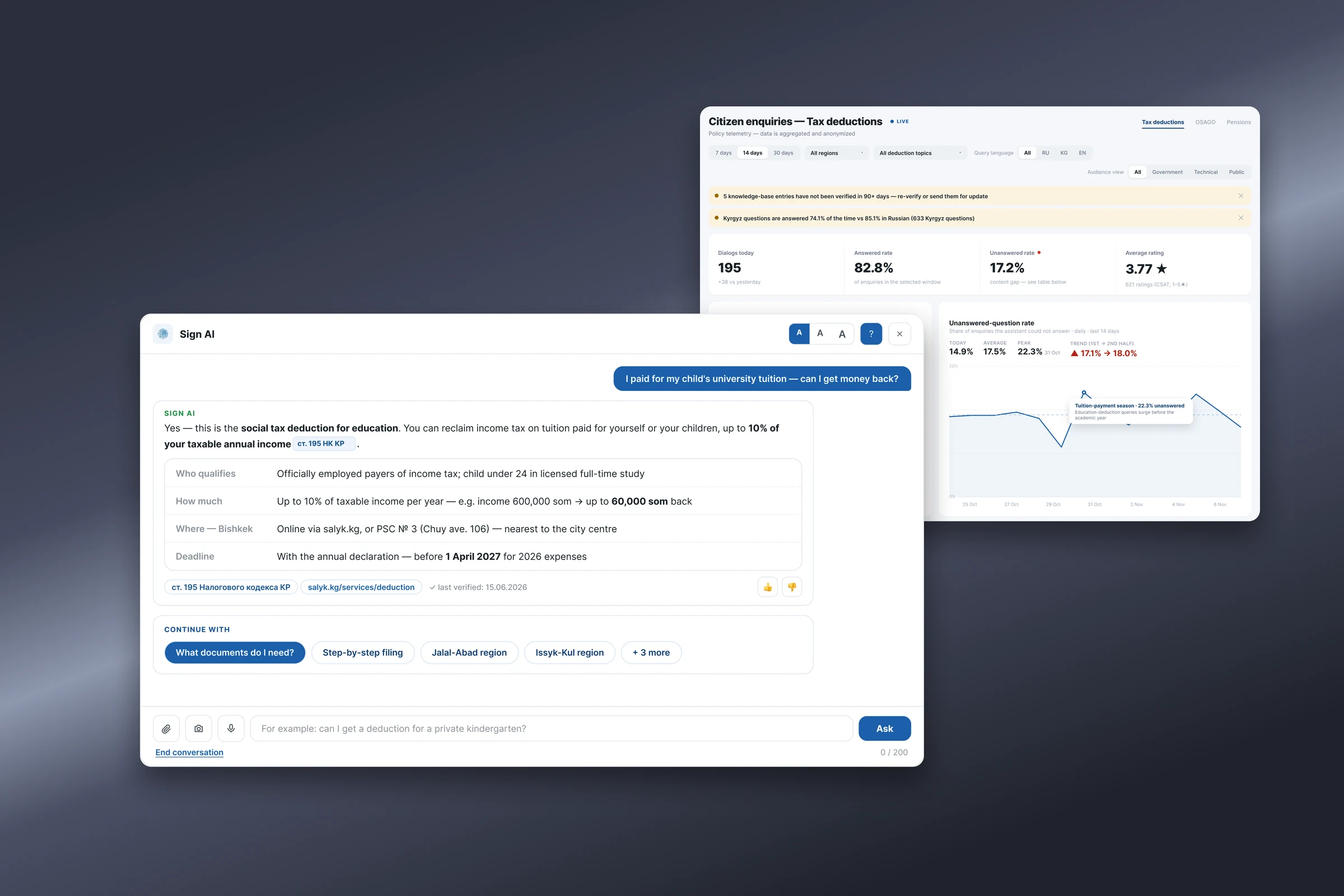
02 · The brief
From a chat box to a public-service AI assistant for citizens
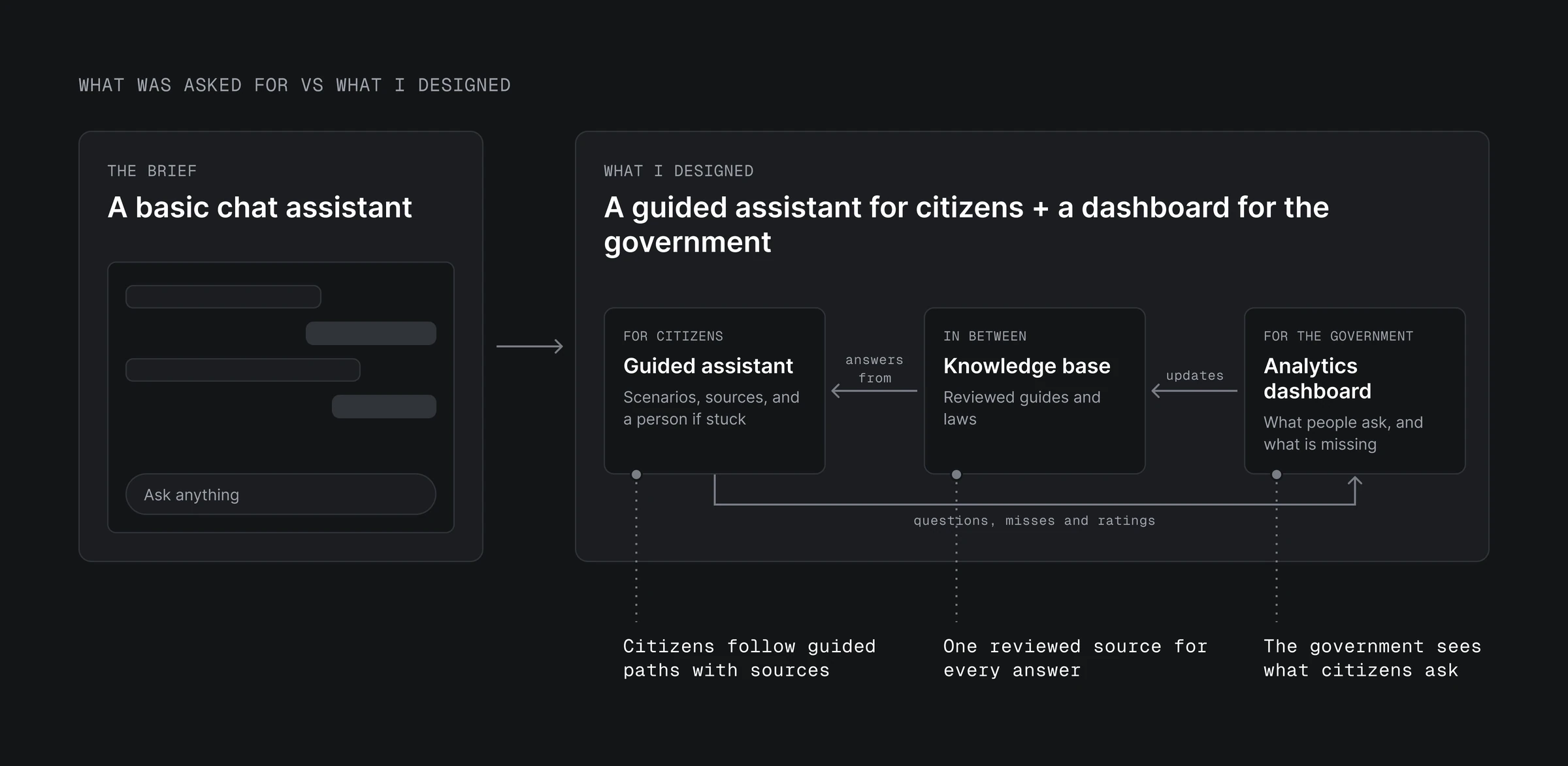
The brief was a basic chat assistant where citizens of Kyrgyzstan ask how to get things done through Tunduk, the national services portal.
A chat box left two questions open. What does the AI say when it isn't sure? And who keeps its answers right when a law changes? For a government, one wrong answer is a public problem. So I designed an assistant that answers only as far as its source allows, and a dashboard that shows each department where answers fall short.
The use case for the pilot: "Can I claim a deduction for my child's tuition?"
02 · The brief
From a chat box to a public-service AI assistant for citizens
- The brief was a basic chat assistant where citizens of Kyrgyzstan ask how to get things done through Tunduk, the national services portal.
- A chat box left two questions open.
- The use case for the pilot: "Can I claim a deduction for my child's tuition?"
03 · Research
Citizens need step-by-step guides, starting with tax deductions
There are two users. The citizen asks the question. The government owns the answer and has to keep it right. Everything below follows from that.
I researched Kazakhstan's AlemGPT and China's State Council service guide. Both showed that quoting a law isn't enough. Citizens also need to know what to do next, and a step-by-step guide tells them. That lesson became the guided path.
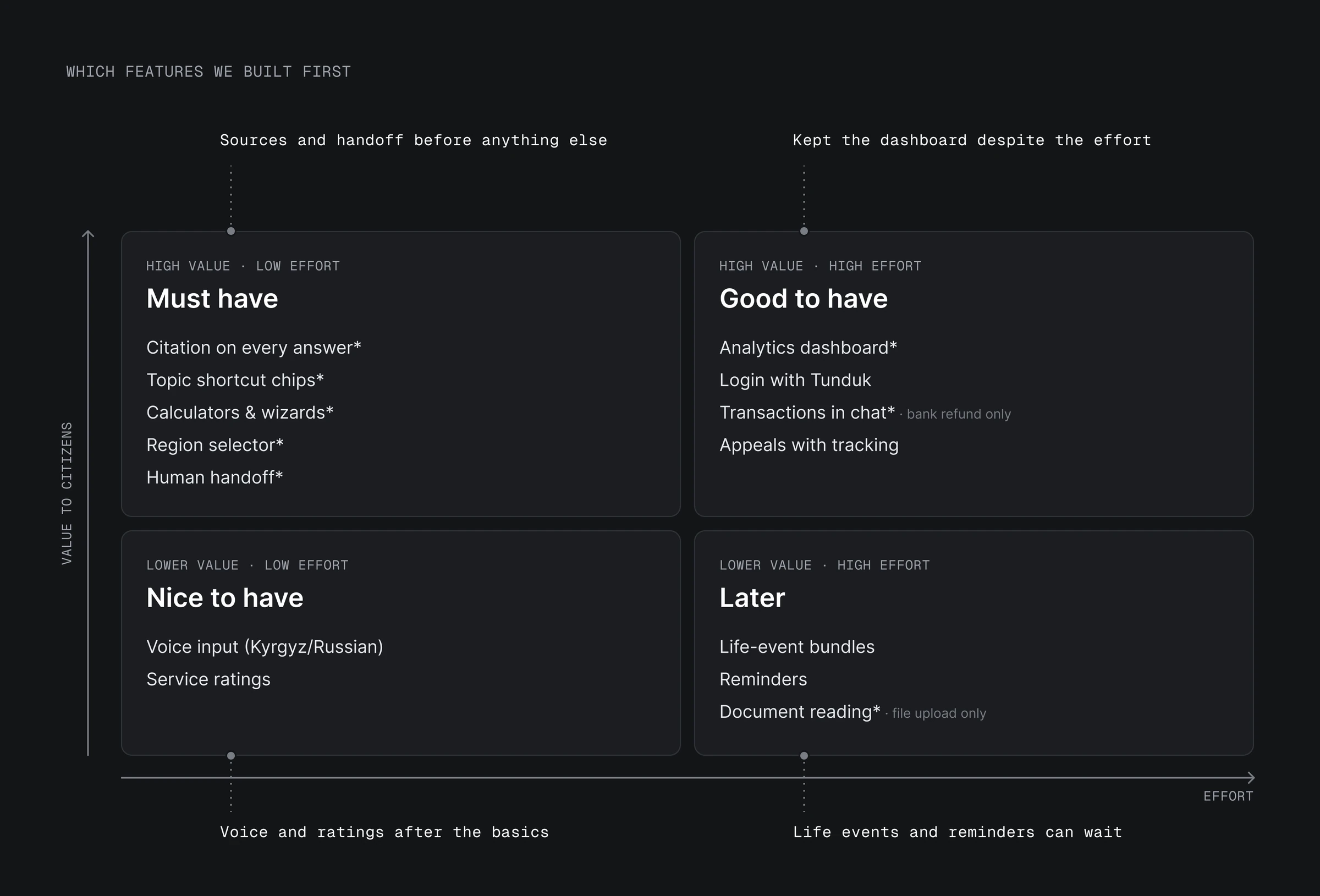
From that research I listed 14 features and sorted them by value to citizens and by effort. Sources on every answer and a handoff to a person came first. The dashboard was high effort, but I kept it: without it, no one in government could see where answers fall short or fix them when a law changes. Life-event bundles and reminders could wait.
Tax deductions came first. Citizens had to find the right rule, check whether they qualify and gather papers alone. Tax also ends in a refund, and the government cared about it most.
03 · Research
Citizens need step-by-step guides, starting with tax deductions
- There are two users: the citizen asks, the government owns the answer and has to keep it right.
- Quoting a law isn't enough. Citizens also need to know what to do next.
- I sorted 14 features by value to citizens and by effort. Sources and a handoff to a person came first.
- Tax deductions came first: citizens worked them out alone, they end in a refund, and the government cared most.
04 · Source rule
The assistant only says what a checked source supports
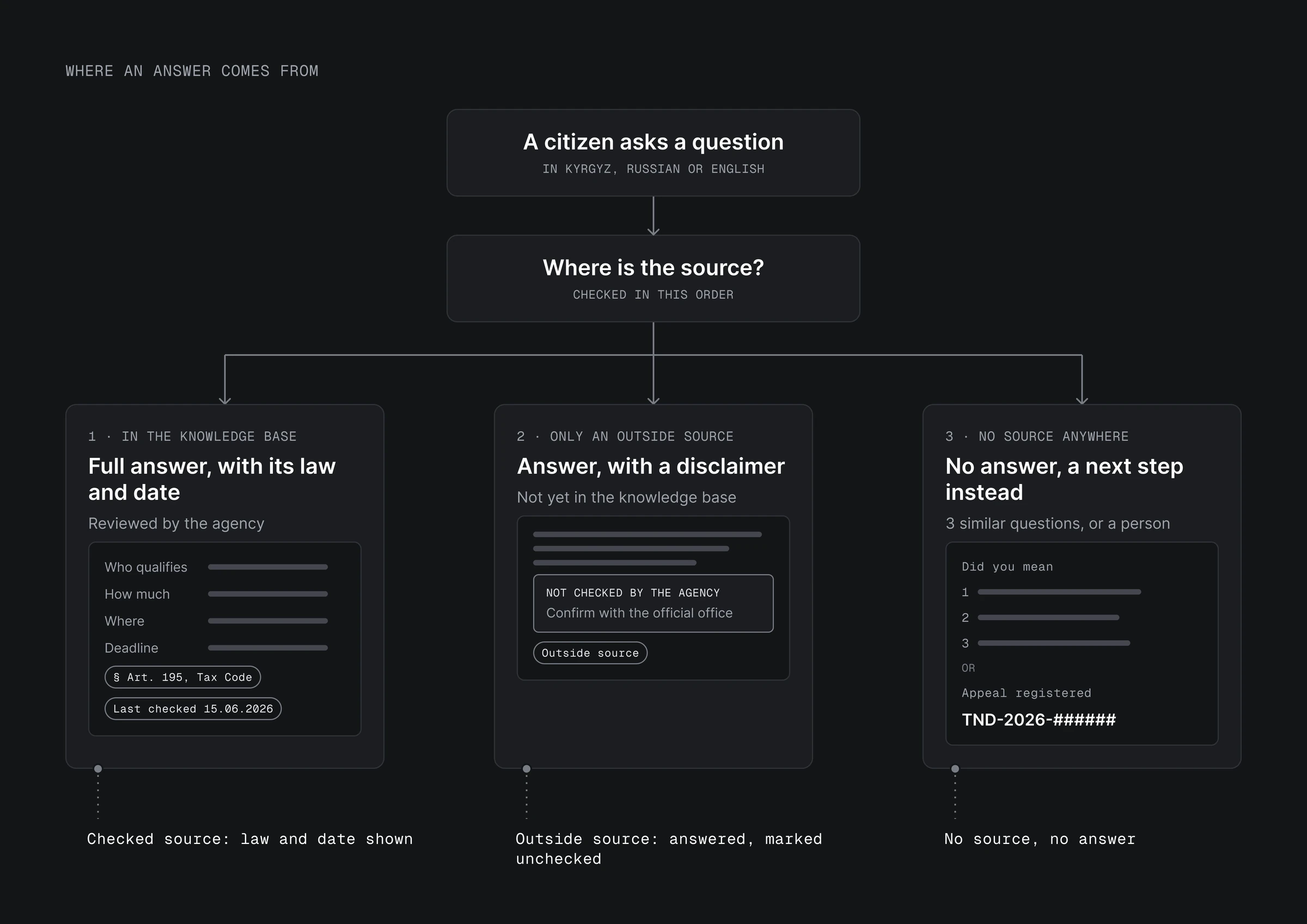
The assistant answers only as far as its source allows, so a citizen never carries the risk of a wrong answer. A blanket "AI may be wrong" note would push that risk onto the citizen instead.
- Checked by the agency: a full answer, with its law and last-checked date.
- Outside source only: an answer marked "Not checked by the agency".
- No source: no answer. The assistant suggests three similar questions, or a person with an appeal tracking number.
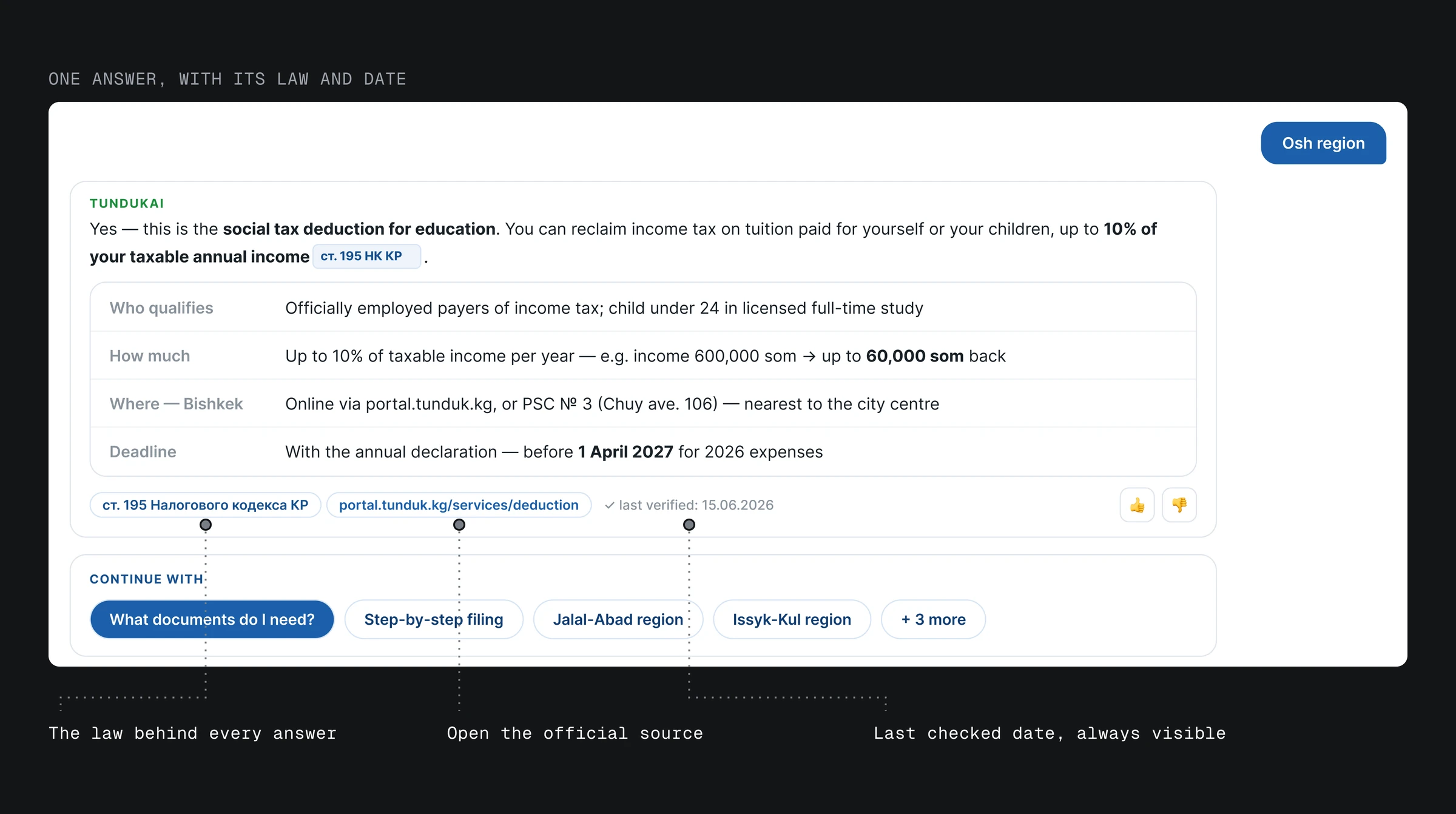
The tuition question is checked, so its answer cites Article 195 of the Tax Code, shows when it was last verified and links to the official source. Who qualifies, how much, where and by when sit in one card.
The cost: the assistant declines more often than a typical chatbot. And the rule can't catch a correct source the AI misreads; the dashboard catches that.
04 · Source rule
The assistant only says what a checked source supports
- The assistant answers only as far as its source allows, so a citizen never carries the risk of a wrong answer.
- Checked by the agency: a full answer, with its law and last-checked date.
- Outside source only: an answer marked "Not checked by the agency". No source: no answer, and a next step instead.
- The cost: the assistant declines more often than a typical chatbot.
05 · Guided path
From the answer to a filed deduction, one question at a time
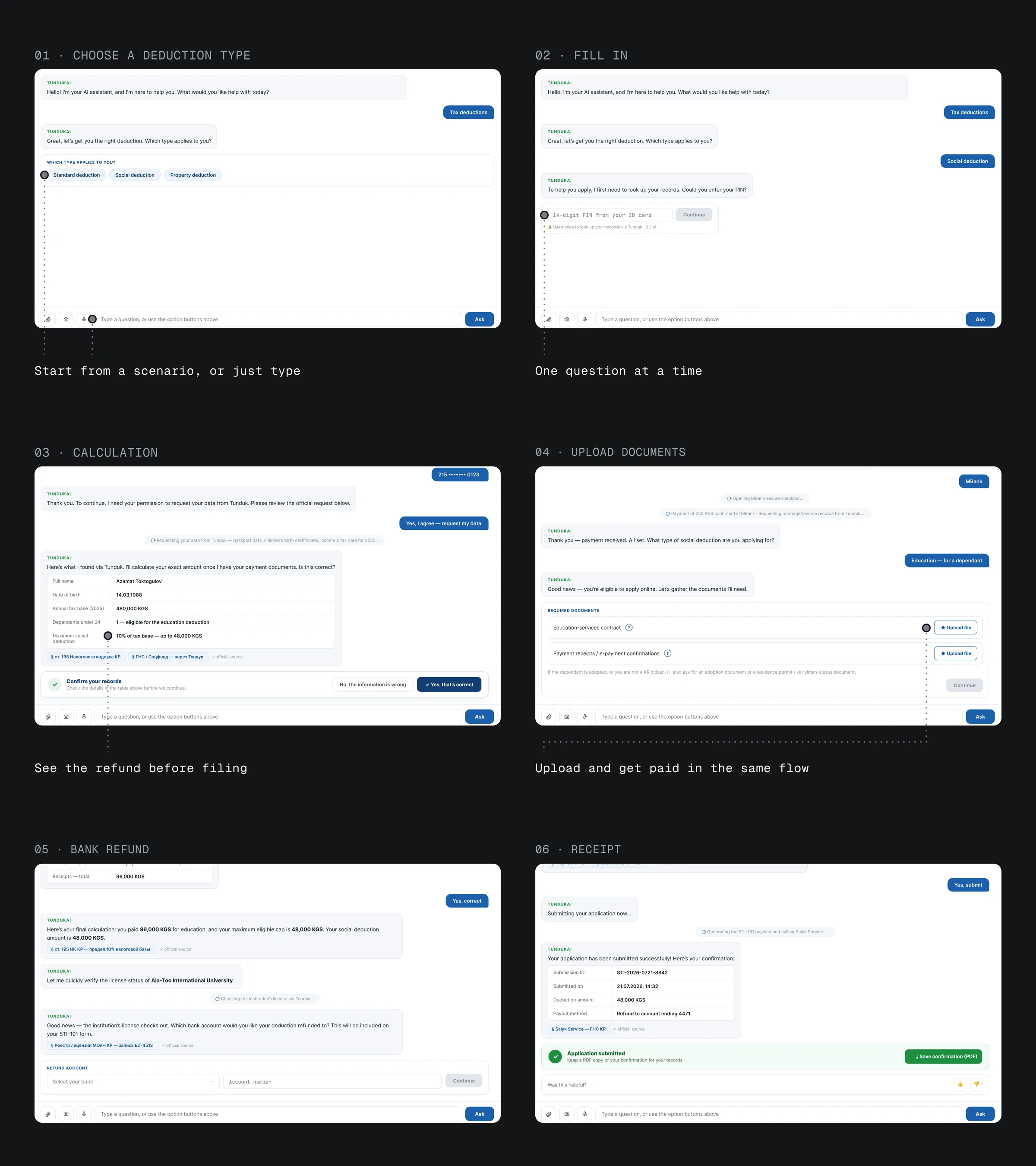
The answer card ends with next steps, one of them "Step-by-step filing". It asks one thing at a time:
- The citizen picks a deduction type: standard, social or property.
- With their permission, the assistant fetches their records from Tunduk.
- It does the math, so they see the refund before filing.
- They upload the tuition contract and receipts, and pick the bank account for the refund.
- A receipt confirms the submission.
Citizens can leave the path and type at any point; the path keeps most questions inside what the AI knows. Each new task needs its own path. Property and business registration were next on the list.
05 · Guided path
From the answer to a filed deduction, one question at a time
- The answer card ends with next steps, one of them "Step-by-step filing".
- The citizen picks a deduction type: standard, social or property.
- With their permission, the assistant fetches their records from Tunduk.
- It does the math, so they see the refund before filing.
06 · Knowledge base management
Each department fixes its own gaps
The source rule stops answers without a source, but laws change and gaps appear, so someone has to keep the knowledge base right. When Sign demoed the prototype to three government contacts in Kyrgyz, Russian and English, they asked exactly that: how do you make sure the answers are trustworthy, and who maintains the knowledge base?
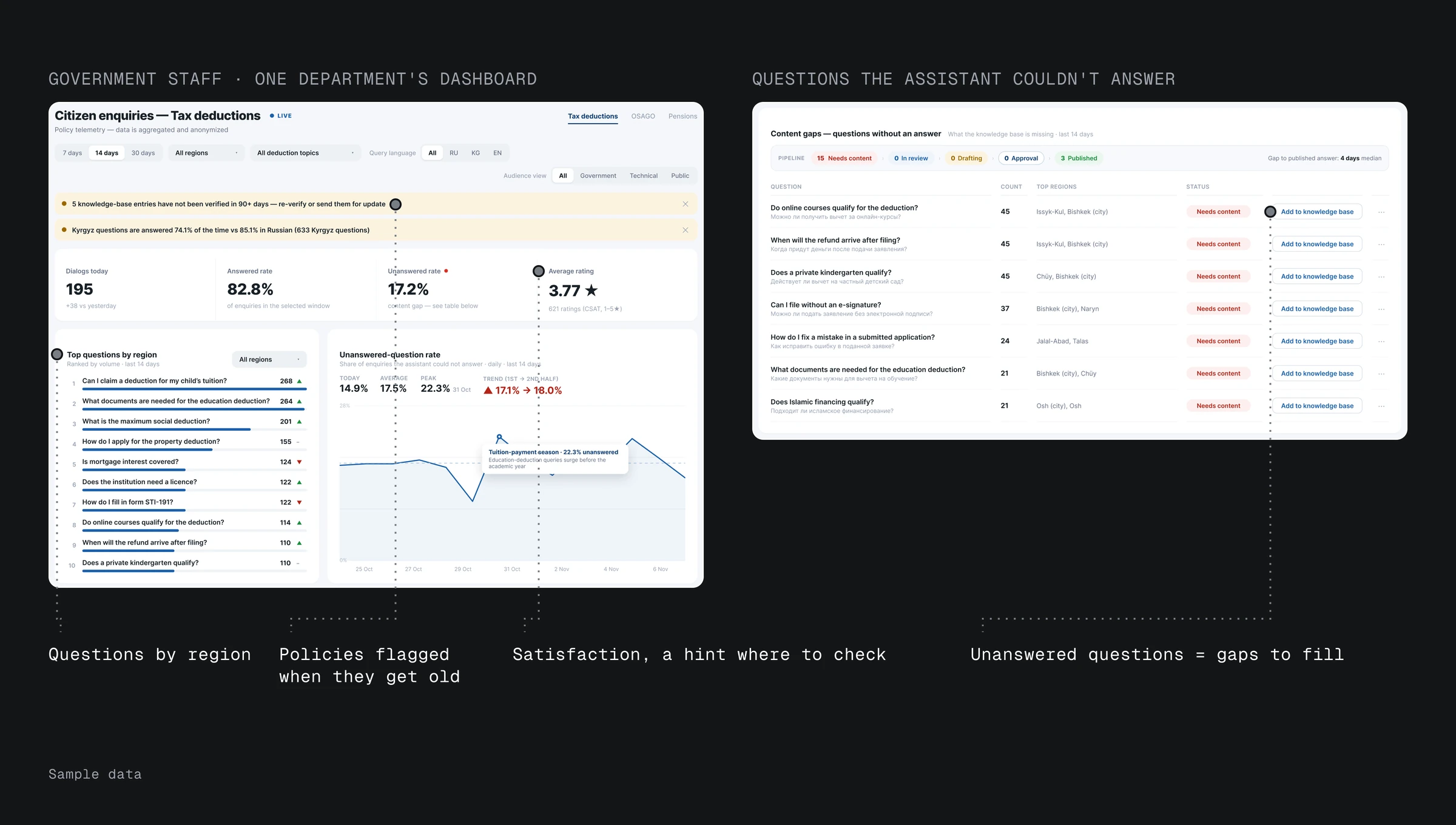
Beyond the brief, I proposed a dashboard for each department, such as finance or transport, which owns its part of the knowledge base. Every number on it leads to an action:
- Top questions by region. In the sample data, the tuition question leads.
- Unanswered questions, such as "Do online courses qualify?", shown as gaps to fill.
- Policies unchecked for 90 days, flagged for update.
- Thumbs-down answers, which staff check first.
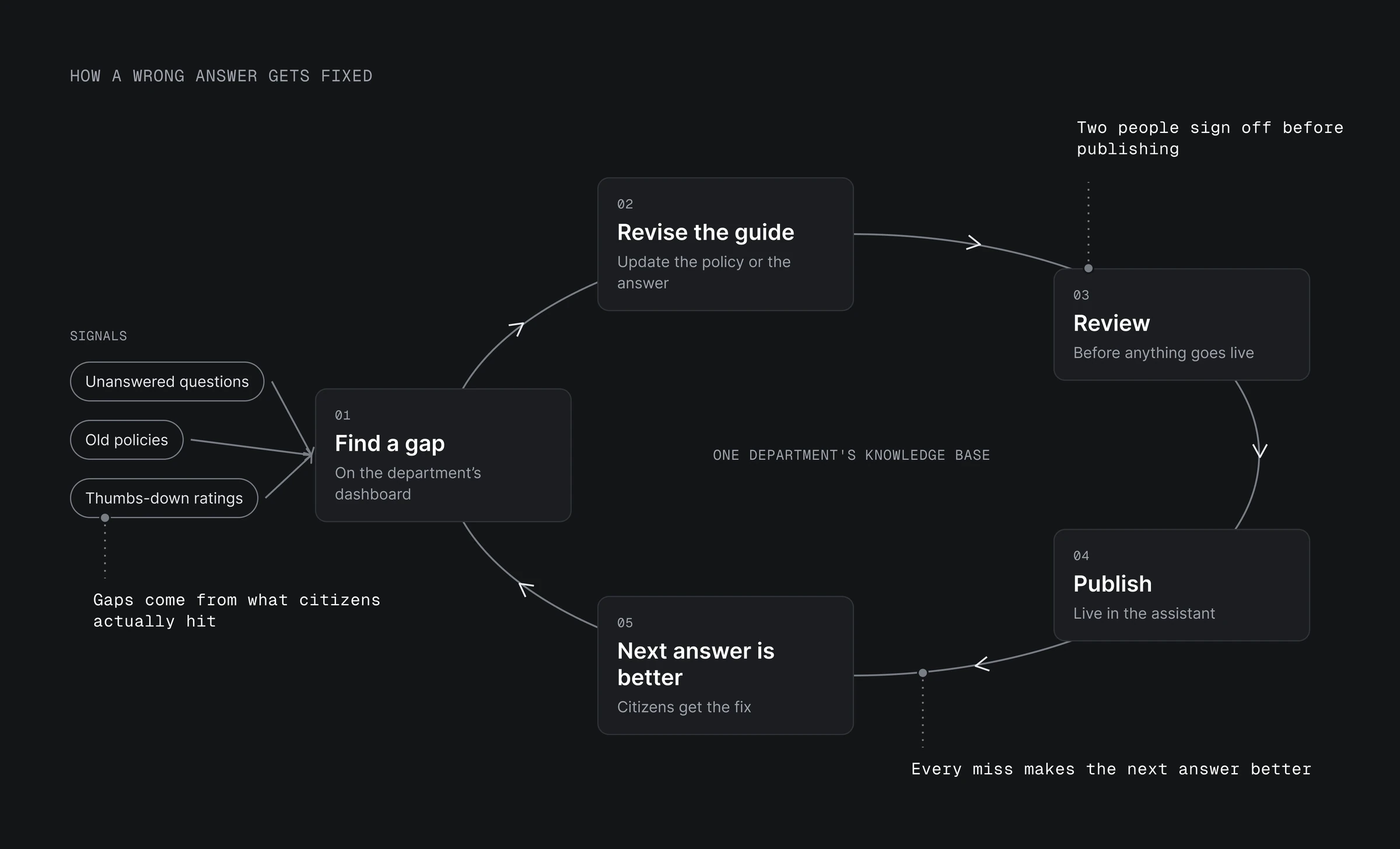
A gap is fixed in four steps (find, revise, review, publish), and two people sign off before it goes live. Fixes take longer, but a rushed fix would put a new wrong answer in front of citizens.
06 · Knowledge base management
Each department fixes its own gaps
- The source rule stops answers without a source, but laws change and gaps appear, so someone has to keep the knowledge base right.
- In the demo, government contacts asked how answers stay trustworthy and who maintains the knowledge base.
- Each department gets a dashboard for its part of the knowledge base, where every number leads to an action.
- A gap is fixed in four steps (find, revise, review, publish), and two people sign off before it goes live.
07 · Result
Demoed to government contacts in Kyrgyz, Russian and English
Sign demoed this design to three government contacts in Kyrgyz, Russian and English.
The assistant has not launched to citizens yet. In a pilot I would measure the share of answers that cite a source, how often questions go unanswered, how often citizens ask again, and whether Kyrgyz questions get answers as good as Russian ones.
07 · Result
Demoed to government contacts in Kyrgyz, Russian and English
- Sign demoed this design to three government contacts in Kyrgyz, Russian and English.